
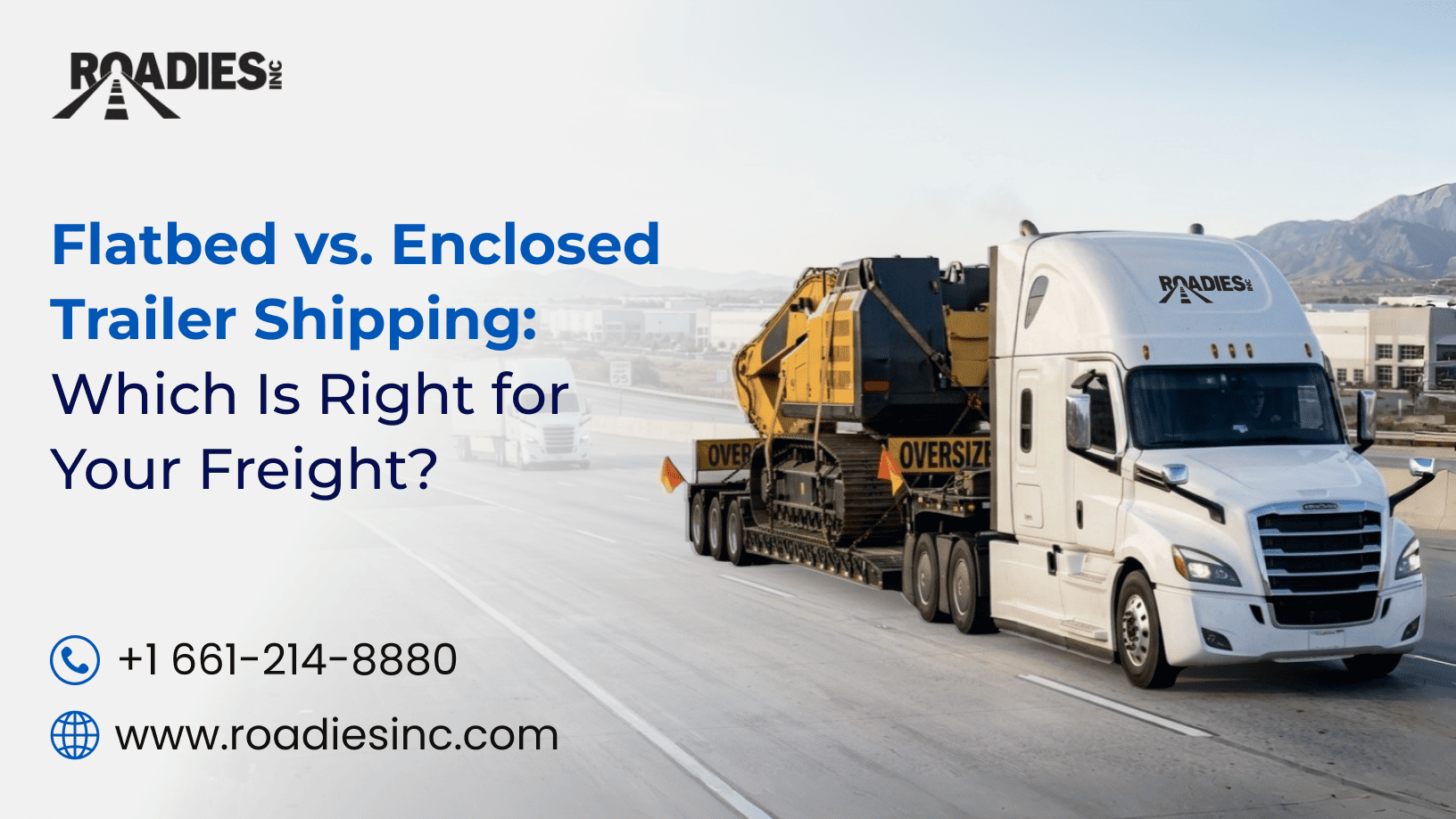
Choosing the right trailer can affect how your freight is loaded, protected, secured, routed, and delivered. For California shippers, the decision can also affect whether additional oversize or overweight planning is required.
The two most common choices for many shipments are flatbed and enclosed trailers. Neither is universally better. The right option depends on the freight’s size, weight, shape, loading method, and protection requirements.
Flatbed or Enclosed?
Choose a flatbed when your freight is oversized, unusually shaped, heavy, or needs flexible loading access.
Choose an enclosed trailer when your freight fits within the trailer’s interior dimensions and needs protection from weather, road debris, or exposure.
For oversized California freight, trailer selection is only one part of the process. Load dimensions, weight, route, securement, and applicable permits also need to be considered. Caltrans issues special transportation permits for qualifying oversize and overweight movements on highways under its jurisdiction.
Flatbed vs. Enclosed Trailer at a Glance
| Factor | Flatbed | Enclosed |
| Design | Open deck | Walls + roof |
| Oversized freight | Better suited | Often limited |
| Irregular shapes | Better suited | May not fit |
| Loading flexibility | High | Moderate |
| Weather protection | Limited | High |
| Road-debris protection | Limited | High |
| Heavy equipment | Commonly suitable | Depends on dimensions |
| Construction materials | Commonly suitable | Less practical |
| Sensitive/valuable freight | Depends on cargo | Often preferred |
| Crane/forklift access | Generally easier | Depends on setup |
When Is Flatbed Shipping the Better Choice?
A flatbed trailer has an open deck without fixed walls or a roof. This gives shippers more flexibility when freight cannot be easily loaded into an enclosed trailer.
Flatbeds are commonly considered for:
- Heavy equipment
- Construction machinery
- Industrial equipment
- Steel
- Lumber
- Large components
- Oversized or irregular freight
The main advantage: loading flexibility
An open deck can make side, rear, top, crane, or forklift loading more practical, depending on the shipment and equipment available.
For example, a large piece of construction equipment may technically be transportable but impossible to load efficiently through an enclosed trailer door. A flatbed can remove that loading constraint.
Roadies Inc. already provides flatbed transportation for oversized and heavy equipment, making this an important consideration when selecting equipment for specialized freight.
Flatbed limitations
The open design also leaves cargo exposed to weather and road conditions. More importantly, cargo must be properly secured.
FMCSA requires applicable commercial cargo to be immobilized or secured against shifting and falling. Its rules include requirements for securement devices, tiedowns, working load limits, and specific provisions for heavy equipment and machinery.
So, “it fits on a flatbed” is not enough. The shipment must also be suitable for safe loading, securement, and transportation.
When Is Enclosed Trailer Shipping the Better Choice?
An enclosed trailer surrounds the cargo with walls and a roof.
That makes it a strong option when cargo protection is more important than open loading flexibility.
Enclosed trailers can be suitable for:
- Electronics
- Furniture
- Packaged goods
- Sensitive equipment
- Valuable cargo
- General freight requiring weather protection
The main advantage: protection
An enclosed trailer provides a physical barrier against rain, wind, sunlight, dust, and road debris.
It also keeps the cargo out of direct view during transportation.
However, enclosed trailers have a major limitation: interior dimensions and access.
If freight is too tall, wide, long, or irregular to fit through the available opening and inside the trailer, an enclosed trailer may not be practical.
5 Factors to Consider Before Choosing
1. Cargo Dimensions
Measure the freight as transported, including its length, width, height, attachments, and packaging, to determine whether it fits an enclosed trailer or needs an open-deck option.
2. Weight
Cargo weight and distribution can affect trailer selection, with heavier equipment potentially requiring a flatbed or specialized trailer configuration.
3. Loading Method
If the freight requires a crane, forklift, side loading, or overhead access, a flatbed may provide greater loading flexibility than an enclosed trailer.
4. Protection Requirements
Choose an enclosed trailer when protection from rain, sunlight, dust, or road debris is important; flatbeds are better suited to freight that can tolerate outdoor exposure.
5. Route & Compliance
For oversized or overweight California shipments, trailer choice must account for route clearances, weight limits, restrictions, and potential permits through Caltrans
Which Trailer Is Best for Different Freight?
| Freight Type | Often Better Option | Why |
| Construction equipment | Flatbed / specialized trailer | Loading and dimensional flexibility |
| Heavy machinery | Flatbed / specialized trailer | Weight and configuration |
| Steel | Flatbed | Length and loading access |
| Lumber | Flatbed | Long or bundled material |
| Oversized equipment | Flatbed / specialized trailer | Open-deck flexibility |
| Electronics | Enclosed | Protection from exposure |
| Furniture | Enclosed | Weather protection |
| Packaged products | Enclosed | Protected environment |
| Sensitive equipment | Enclosed | Reduced environmental exposure |
| Irregular machinery | Flatbed | Fewer dimensional restrictions |
These are general guidelines, not automatic rules. Cargo dimensions, weight, loading requirements, and route conditions should determine the final equipment choice.
California Flatbed Shipping: When Permits May Matter
A flatbed does not automatically make an oversized shipment legal.
Caltrans states that oversize/overweight permits can apply when a vehicle or load exceeds applicable length, width, height, or weight limits and meets the requirements for a permit. Loads generally must be reasonably non-divisible to qualify.
For example, Caltrans’ current permit information includes different permit categories based on the dimensions and characteristics of the movement.
For a California oversized shipment, planning should therefore consider:
Cargo dimensions → total weight → trailer configuration → route → securement → permits
Accurate information before pickup can prevent costly transportation problems later.
What to Have Ready for a Trailer Shipping Quote
| Key Information | Why It Matters for Trailer Selection |
| Cargo type | Determines whether flatbed or enclosed transportation is more suitable for the freight. |
| Length × Width × Height | Shows whether the cargo can fit inside an enclosed trailer or requires an open-deck option. |
| Total weight | Helps determine the appropriate trailer and whether specialized equipment may be needed. |
| Loading method | Forklift, crane, dock, or other loading requirements can influence the trailer configuration. |
| Pickup & delivery locations | Helps evaluate route, site access, and transportation requirements. |
| Weather/protection needs | Sensitive or valuable cargo may favor an enclosed trailer, while durable or oversized freight may be better suited to a flatbed. |
| Photos of the cargo | Useful when the freight has an unusual shape, attachments, or special loading requirements. |
How Roadies Inc. Helps Choose the Right Trailer
The right trailer should be selected around the freight, not the other way around.
Roadies Inc. provides multiple transportation options, including flatbed, enclosed, open-air, and car trailer services, along with broader logistics and shipping solutions.
For businesses moving freight, the process starts with understanding:
- What is being shipped
- Cargo dimensions
- Weight
- Loading requirements
- Protection requirements
- Pickup and delivery locations
- Any unusual transportation requirements
That information helps determine the most practical transportation solution for the shipment.
Not sure whether your freight needs a flatbed or enclosed trailer? Contact Roadies Inc. with your cargo dimensions, weight, pickup location, and destination to discuss the right transportation option.
Frequently Asked Questions
Is a flatbed or enclosed trailer better for oversized freight?
A flatbed is generally better suited to oversized or irregular freight because the open deck provides greater loading and dimensional flexibility. Some loads may require specialized equipment instead.
Is flatbed shipping cheaper than enclosed shipping?
Not always. Pricing depends on freight dimensions, weight, distance, equipment availability, loading requirements, routing, and potential permit or special-handling requirements.
What is an enclosed trailer best for?
Enclosed trailers are generally best for freight that fits within the available interior dimensions and needs additional protection from weather, road debris, or exposure.
Can heavy equipment be transported on a flatbed?
Yes, depending on the equipment’s dimensions, weight, configuration, and applicable transportation requirements. Some heavy or tall equipment may require a specialized trailer.
Does flatbed freight need to be secured?
Yes. Applicable commercial cargo must be properly secured against movement. FMCSA has specific cargo-securement requirements, including provisions for heavy equipment and machinery.
Do oversized loads require permits in California?
Some qualifying oversize or overweight movements require special transportation permits. Requirements depend on the load, vehicle, dimensions, weight, and route.
