
Operating through the San Pedro Bay port complex, comprising the Port of Los Angeles and the Port of Long Beach, remains a double-edged sword for North American supply chains. As the nation’s primary gateway for trans-Pacific trade, these dual ports move millions of Twenty-Foot Equivalent Units (TEUs) annually.
However, for logistics directors and freight managers, shipping through Southern California often means managing unpredictable rail dwell times, strict gate appointment windows, and compounding terminal access fees.
When port congestion strikes, delays rarely manifest as long lines of ships anchored offshore. Instead, congestion hits the balance sheet through stacked accessorial fees, missed delivery windows, and strained drayage capacity.
To protect landed costs and maintain supply chain velocity, shippers require proactive, field-tested logistics strategies designed specifically for the Southern California shipping ecosystem.
The San Pedro Bay Port Environment: Volume, Dwell, and Bottlenecks
Modern port congestion is driven by operational friction points on the landside terminal rather than offshore vessel queues:
Local Drayage vs. Rail Dwell Divergence
Truck-delivered local cargo generally moves with high fluidity across terminal gates, maintaining average street dwell times under 3 days. Conversely, intermodal rail-bound cargo experiences volatile dwell spikes, often exceeding 5 to 7 days, due to railcar shortages and terminal staging bottlenecks at regional rail ramps (such as BNSF Hobart or Union Pacific ICTF).
Tariff Surges & Front-Loading
Shifted trade policies and regulatory deadlines frequently trigger sudden “front-loading” import surges. When ocean carriers drop high volumes of containers within short windows, marine terminal yards become crowded, slowing down container pick-and-stage operations.
Chassis Pool Imbalances
High cargo volumes often exhaust the supply of local 40ft and 53ft chassis. When marine terminals experience chassis shortages, drayage drivers cannot pull import containers, even if the container is marked clear for pickup.
Decoding the SoCal Drayage “Fee Stack”: Where Landed Margins Are Lost
Unmitigated port delays quickly turn into direct financial penalties. Understanding the fee structure is the first step toward eliminating preventable freight spend:
| Fee / Accessorial Type | Operational Trigger & Cost Impact |
| Traffic Mitigation Fee (PierPass) | Charged on non-exempt loaded containers moving during daytime peak hours ($40.63/TEU; $81.26/FEU). |
| Clean Truck Fund (CTF) Rate | $10 per loaded TEU ($20/FEU) assessed on non-ZEV drayage trucks entering port container terminals. |
| Terminal Demurrage | Daily storage fees assessed by ocean carriers after Last Free Day (LFD) expires ($200–$500+/day). |
| Equipment Per-Diem | Daily retention fees for holding ocean containers or marine chassis past free time allowances. |
The Last Free Day (LFD) Trap: Ocean carriers typically grant 2 to 4 days of “free time” before assessing daily demurrage penalties. If a shipper cannot secure a terminal appointment or a chassis before the LFD expires, storage fees accumulate exponentially.
The Accessorial Multiplier: A single delayed container can incur simultaneous demurrage, chassis per-diem, and driver wait time charges, easily adding over $1,000 per container to overall shipping spend. For a broader analysis of how hidden charges impact linehaul spend, review our breakdown on truckload shipping costs and average rates.
Strategic Action 1: Pre-Pulls and Off-Dock Yard Buffers
When a consignee’s receiving warehouse is backed up or terminal appointment slots are unavailable near the Last Free Day, relying on direct-to-door drayage risks severe demurrage penalties.
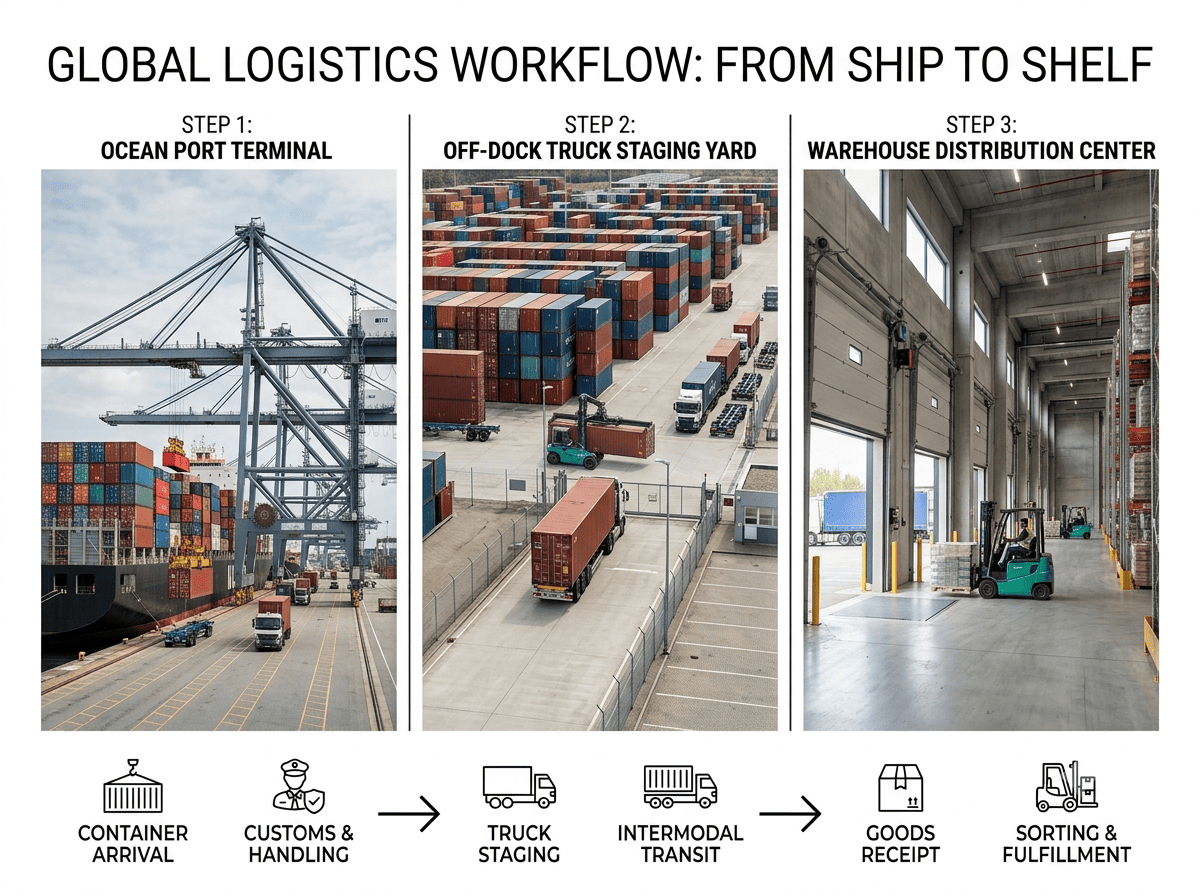
Executing a pre-pull involves having a drayage partner retrieve the container from the marine terminal before the LFD expires and move it to a secure off-dock staging yard:
Demurrage Capping: Pulling the container off the marine terminal immediately stops the ocean carrier’s compounding demurrage clock.
Flexible Delivery Scheduling: Staging cargo in an off-dock yard allows the drayage carrier to deliver the load during non-peak hours or when the receiving facility is fully prepared, eliminating costly driver detention charges at the destination dock.
Strategic Action 2: Inland Transloading & Cross-Docking Hubs
Long-distance inland drayage, hauling heavy 20ft or 40ft ocean containers hundreds of miles inland, exposes shippers to high chassis per-diem fees, weight limits, and equipment return hassles.
| Direct Ocean Drayage | Strategic Inland Transloading |
| High chassis per-diem risk | Ocean equipment returned immediately to port |
| Strict ocean container weight caps | 3x 40ft ocean loads fit into 2x 53ft trailers |
| Slower, single-route delivery | Freight sorted & routed to multiple regional hubs |
By utilizing strategic transloading and cross-docking facilities located along major freight corridors, such as Bakersfield in California’s Central Valley, shippers unlock significant operational advantages:
Immediate Equipment Return: Cargo is transferred from marine containers into domestic 53ft dry vans or flatbeds near the port or inland transit nodes, allowing ocean containers and chassis to be returned quickly to avoid per-diem penalties.
The 3-for-2 Capacity Ratio: Volume-based transloading enables logistics providers to consolidate freight from three 40ft ocean containers into two 53ft domestic trailers, cutting long-haul over-the-road freight costs by roughly 33%.
Bypassing Coastal Warehousing Bottlenecks: Real estate and dock space around the Los Angeles/Inland Empire logistics basins are heavily congested. Utilizing Central Valley cross-docking solutions provides a cost-effective staging ground to distribute freight across California, the Pacific Northwest, and the Southwest. To evaluate whether this model matches your commodity type, read our analysis on whether cross-docking is right for your freight.
Strategic Action 3: Tech-Driven Visibility & Active Chassis Management
Managing Southern California port freight requires proactive terminal tracking rather than reactive phone calls:
Automated Terminal API Tracking: Modern logistics providers integrate directly with marine terminal operating systems (TOS) to monitor Customs holds, Steamship Line (SSL) releases, Earliest Return Dates (ERD), and Last Free Days (LFD) in real time. For more information on federal guidelines governing marine terminal operations, visit the Federal Maritime Commission (FMC).
Leveraging “Chassis Choice”: Under current FMC regulations and Ocean Shipping Reform Act (OSRA) guidelines, shippers and motor carriers have greater flexibility in selecting Intermodal Equipment Providers (IEPs), reducing dependency on congested terminal chassis pools. Review our detailed guide on why real-time tracking is a game-changer in logistics to see how telematics protects shipment timelines.
Protect Your Supply Chain Velocity with Roadies Inc.
Navigating Southern California port logistics requires more than basic trucking, it demands responsive drayage management, strategic off-dock staging, and efficient transloading capabilities.
At Roadies Inc., we provide specialized freight solutions engineered to keep your cargo moving. From agile California drayage execution and reliable freight brokerage to flexible cross-docking operations in Bakersfield, our team helps B2B shippers eliminate unnecessary port accessorials and streamline West Coast distribution.
Contact Roadies Inc. today to audit your Southern California port strategy and protect your landed freight costs.
Frequently Asked Questions (FAQs)
How long is ocean container free time at the Ports of Los Angeles and Long Beach?
Ocean carrier free time generally ranges from 2 to 4 business days after a container is discharged from the vessel and placed in an available stack. Once free time expires, daily demurrage charges apply until the container is retrieved from the terminal.
What is the difference between port demurrage and container detention?
Demurrage is assessed by marine terminals or ocean carriers when an import container remains inside the port gate past its Last Free Day. Detention (or per-diem) is charged when an ocean container or chassis is removed from the port but not returned to the designated equipment yard within the agreed free-time window.
How does the PierPass Traffic Mitigation Fee (TMF) work?
Managed by the West Coast Marine Terminal Operators Agreement (WCMTOA), PierPass assesses a TMF ($40.63 per TEU / $81.26 per FEU) on non-exempt loaded containers moving through terminal gates during day shifts. The fee offsets extended terminal gate operating costs.
Can transloading help reduce container weight violations in California?
Yes. Ocean containers are subject to strict weight limits under California Department of Transportation (Caltrans) highway regulations. Transloading heavy ocean cargo into domestic 53ft trailers or specialized flatbed units allows shipments to be rebalanced, eliminating overweight axle citations.
What is a drayage pre-pull, and when should I use it?
A pre-pull occurs when a motor carrier retrieves a container from the port before its Last Free Day and temporarily holds it in a secure off-dock yard. Shippers use pre-pulls when receiving facility docks are full or when terminal appointments are unavailable on the target delivery date.
