
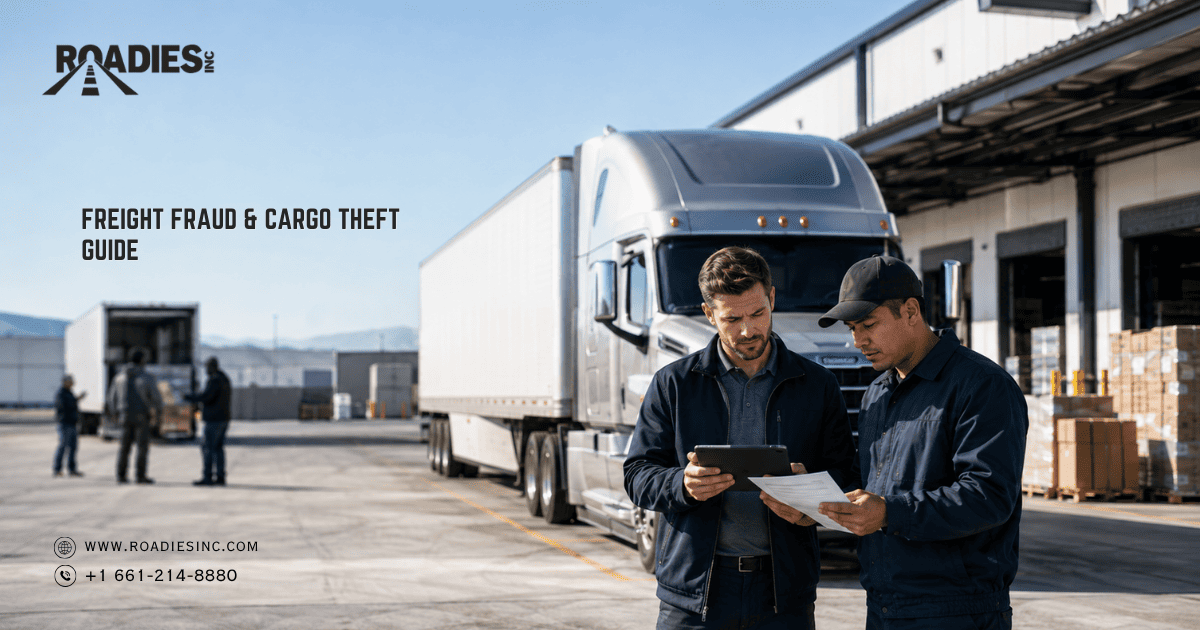
Cargo theft in California isn’t a warehouse problem anymore. It’s an identity fraud problem, a fake-carrier problem, and a double-brokering problem, and the losses are getting bigger even as the tactics get harder to detect.
Key Takeaways
- Cargo theft losses more than doubled in Q2 2026, reaching $304.6 million — up from $135.7 million in Q2 2025. (Source: Verisk CargoNet, August 2026)
- California is the #1 cargo theft state in America, accounting for 36–38% of all incidents nationwide in both 2025 and Q1 2026.
- Deceptive pickup schemes — fake carriers using stolen identities to pick up legitimate loads — jumped 31% year-over-year in Q1 2026. Nearly half occurred in California.
- Half of all fraud incidents in Q1 2026 involved carriers with clean records — meaning standard vetting wouldn’t have caught them. (Source: Highway Freight Fraud Index)
- The SAFER Transport Act, introduced February 2026, would create federal criminal penalties for registration fraud, establish a Freight Fraud Advisory Committee, and phase out MC numbers in favor of USDOT numbers.
- Your best defense isn’t technology alone — it’s working with asset-based carriers and vetted brokers who control the chain from pickup to delivery.
The Numbers Are Getting Worse, Not Better
The headline figures tell the story:
| Metric | Data | Source |
| Q2 2026 cargo theft losses | $304.6 million (more than double Q2 2025) | Verisk CargoNet |
| Q1 2026 total theft incidents | 574 nationwide, averaging 6.4 per day | Overhaul |
| 2025 full-year losses | $725 million — a 60% surge from 2024 | Verisk CargoNet |
| Average loss per theft event (2025) | $273,990 — up 36% in one year | CargoNet |
| California’s share of incidents | 36–38% of all U.S. cargo theft | Overhaul / CargoNet |
| Deceptive pickup schemes (Q1 2026) | Up 31% year-over-year | Overhaul |
| Ownership-change fraud (Q1 2026) | Up 169.6% year-over-year | Highway |
What makes 2026 different from previous years isn’t the volume, total incident counts actually dipped slightly in Q1. It’s the severity. Criminals are going after higher-value targets with more sophisticated methods, and the per-incident losses are climbing fast.
How Freight Fraud Actually Works
If you’re a shipper who hands freight to a carrier and expects it to arrive, here are the scams that can intercept it:
Double Brokering
A broker accepts your load, then secretly re-brokers it to another carrier without your knowledge. You lose visibility on your freight. Insurance often won’t cover cargo that’s been double-brokered because the actual hauling carrier can’t be verified. The legitimate carrier who delivers the load may never get paid, and when they don’t, they come after the shipper.
Fictitious Pickups
Criminals obtain your shipment details, through phishing, data breaches, or simply monitoring load boards, and show up at your dock before the real carrier arrives. They present fake paperwork, load your freight, and disappear. By the time you realize the real driver never showed, the cargo is gone.
Carrier Identity Theft
Scammers copy the DOT and MC numbers of a legitimate, established carrier and use that stolen identity to book loads. On paper, everything checks out, real operating history, real insurance, real authority. But the truck that arrives isn’t the real carrier. Highway’s Q1 2026 Freight Fraud Index found that half of all fraud incidents involved carriers with clean records, meaning standard database vetting alone wouldn’t have flagged them.
Hostage Loads
A carrier picks up your freight legitimately, then holds it hostage, refusing delivery until you pay an inflated rate. This is especially common with double-brokered loads where the actual hauling carrier discovers they were underpaid and demands the difference from the shipper or broker.
What’s Happening in California Specifically
California isn’t just part of the freight fraud problem, it’s the epicenter.
The State Leads the Nation in Cargo Theft
Overhaul’s Q1 2026 report found that 36% of all U.S. cargo theft incidents occurred in California. In 2025, that number was 38%. California and Texas together account for nearly 60% of all incidents nationwide, but California’s share is growing while other regions see declines.
Organized Crime Is Driving the Shift
Verisk CargoNet’s Q2 2026 analysis pointed to a clear pattern: reduced activity from smaller domestic criminal groups in Texas and the Southeast, paired with sustained or growing activity by organized crime networks with a nexus in California and the New York City metro area. In March 2026, the LA County Sheriff’s Department arrested nine suspects and charged them with stealing over $7 million in goods from companies including TJ Maxx, Costco, and Disney.
Most Targeted Freight Categories
Electronics remain the most frequently stolen category at 17% of all incidents, followed by food and beverage at 15%. Auto parts saw the sharpest spike, thefts jumped 142% from Q4 2025 to Q1 2026. Most theft happens at rest: 41% occurs at warehouse storage facilities and 16% in unsecured parking lots.
What Congress Is Doing: The SAFER Transport Act
On February 26, 2026, Senator Todd Young introduced the SAFER Transport Act, the most significant federal legislation targeting freight fraud in years. The bill addresses the systemic weaknesses that have allowed scams to proliferate:
- Creates a Freight Fraud and Theft Advisory Committee under the Secretary of Transportation to develop industry-wide countermeasures.
- Phases out MC numbers in favor of a unified USDOT number system, making it harder for criminals to hide behind duplicate or fabricated authorities.
- Establishes new criminal penalties for registration fraud and fraudulent certifications.
- Strengthens interagency coordination across the DOT, Department of Justice, and Customs & Border Protection for freight theft enforcement.
- Closes regulatory loopholes involving foreign dispatch services that have been used to orchestrate fraud remotely.
The bill has bipartisan support and is backed by the American Trucking Associations, OOIDA, and the Transportation Intermediaries Association. The companion bill (CORCA) has over 200 co-sponsors in the House. As of August 2026, the legislation is moving through committee.
How to Protect Your Shipments
No single tool stops freight fraud. It takes layered verification at every handoff point:
Verify the Carrier, Not Just the Paperwork
Check USDOT and MC numbers through FMCSA’s SAFER system before every load, not just during onboarding. Confirm the carrier’s insurance is active and matches the entity on the rate confirmation. Cross-reference the driver’s phone number, truck number, and location against what the carrier provided.
Work with Asset-Based Carriers and Vetted Brokers
The simplest way to reduce fraud exposure is to move freight with carriers who own their trucks and employ their drivers, not anonymous capacity pulled from a load board. When you know the truck, the driver, and the dispatcher, the chain of custody is visible from pickup to delivery.
This is where working with an established freight brokerage matters. A good broker doesn’t just find a truck, they verify the carrier’s identity, confirm operating authority, validate insurance, and monitor the load in transit. Here’s our guide on how to choose a freight brokerage partner in California that actually protects your freight.
Use Real-Time Tracking on Every Load
GPS tracking that shows real-time location and route deviation isn’t optional anymore, it’s your earliest warning that something is wrong. If a load goes off-route or stops in an unexpected location, you want to know in minutes, not days. Roadies Inc uses technology and fleet management tools across every shipment for exactly this reason.
Tighten Dock Procedures
Verify every driver’s identity against the BOL at pickup. Don’t release freight to anyone who arrives unscheduled. Use appointment-based dock scheduling and require matching reference numbers before loading.
How Roadies Inc Keeps Your Freight Secure
At Roadies Inc, freight security isn’t a feature, it’s how we operate.
We’re an asset-based Bakersfield trucking company with our own trucks and our own drivers. When you book a freight shipment with us, you know exactly which truck and which driver is picking up your load. Our logistics systems provide real-time visibility from pickup to delivery, no blind handoffs, no anonymous capacity, no gaps in the chain of custody.
When loads move through our brokerage network, every carrier is vetted against FMCSA records, insurance is verified per-load, and tracking is required. We don’t source trucks from open load boards and hope for the best.
In a market where half of all fraud involves carriers that look legitimate on paper, the difference is knowing who’s actually behind the wheel.
Ship with a carrier you can verify. Contact Roadies Inc today. Call 661-214-8880.
Frequently Asked Questions
What is the most common type of freight fraud in 2026?
Deceptive pickup schemes, where criminals use fake identities and forged credentials to pick up legitimate loads, jumped 31% year-over-year in Q1 2026 and accounted for nearly half of all fraud incidents in California. Carrier identity theft and double brokering remain the other top threats.
How much does cargo theft cost the trucking industry?
Cargo theft losses reached $304.6 million in Q2 2026 alone, more than double the same quarter in 2025. Full-year 2025 losses hit a record $725 million nationwide, with an average loss of $273,990 per event.
Why is California the #1 state for cargo theft?
California accounts for 36–38% of all U.S. cargo theft incidents due to its massive port volumes (LA/Long Beach), dense freight corridors, high-value cargo categories, and the presence of organized crime networks that target the supply chain.
What is double brokering and why is it dangerous?
Double brokering happens when a broker secretly re-brokers your load to another carrier without your knowledge. You lose visibility on your freight, insurance coverage may be voided, and the actual hauling carrier may go unpaid, creating payment disputes that come back to the shipper.
What is the SAFER Transport Act?
Introduced in February 2026 by Senator Todd Young, the SAFER Transport Act creates federal criminal penalties for freight fraud, establishes a Freight Fraud Advisory Committee, phases out MC numbers for a unified USDOT system, and strengthens enforcement coordination across federal agencies. It has bipartisan support and over 200 House co-sponsors.
